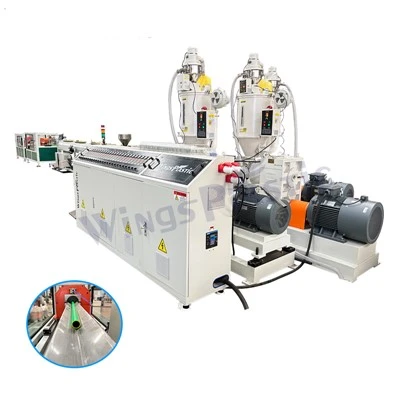
In the modern manufacturing landscape, the concept of remote operation has gained significant traction due to its potential to enhance efficiency, reduce costs, and improve safety. As a reputable supplier of PVC pipe machines, I often encounter inquiries from customers about the feasibility of remotely operating our equipment. In this blog post, I will delve into this topic, exploring the technical aspects, benefits, challenges, and potential future developments of remote operation for PVC pipe machines. PVC Pipe Machine
Technical Feasibility of Remote Operation
The technological advancements of recent years have made it possible to remotely operate a wide range of industrial machinery, including PVC pipe machines. At the core of this capability is the integration of IoT (Internet of Things) technology. By equipping PVC pipe machines with sensors and connectivity modules, we can collect real – time data on various parameters such as temperature, pressure, speed, and production volume. This data is then transmitted to a central control system via a secure network, which can be accessed remotely through a dedicated software interface.
For example, the temperature of the extrusion process is a critical factor in PVC pipe production. With remote operation, operators can monitor the temperature in real – time and make adjustments as needed. This is achieved through thermocouples installed at key points in the machine, which send temperature readings to the control system. If the temperature deviates from the set range, the operator can remotely adjust the heating elements to bring it back to the optimal level.
In addition to sensor data, modern PVC pipe machines are also equipped with actuators that can be controlled remotely. These actuators are responsible for functions such as starting and stopping the machine, adjusting the speed of the extruder, and controlling the cutting mechanism. Through the remote control interface, operators can send commands to these actuators, effectively controlling the entire production process from a distance.
Benefits of Remote Operation
1. Enhanced Efficiency
Remote operation allows for continuous monitoring and adjustment of the PVC pipe production process. Operators can respond to issues in real – time, reducing downtime and improving overall productivity. For instance, if a blockage occurs in the extrusion die, the operator can immediately stop the machine and initiate a cleaning procedure without having to be physically present at the production site. This minimizes the impact on production schedules and reduces waste.
2. Cost Savings
By enabling remote operation, companies can reduce labor costs associated with on – site supervision. Instead of having multiple operators stationed at each machine, a single operator can monitor and control multiple PVC pipe machines from a central location. Additionally, remote operation can help in optimizing energy consumption. Operators can adjust the machine settings based on real – time energy usage data, leading to significant cost savings in the long run.
3. Improved Safety
In the PVC pipe manufacturing process, there are several potential safety hazards, such as high temperatures, moving parts, and exposure to chemicals. Remote operation eliminates the need for operators to be in close proximity to these hazards. They can monitor and control the machines from a safe location, reducing the risk of accidents and injuries.
Challenges of Remote Operation
1. Cybersecurity
As PVC pipe machines become more connected, they are also vulnerable to cyber threats. Hackers can potentially gain access to the control system and disrupt the production process, steal sensitive data, or even cause physical damage to the machines. To address this challenge, it is essential to implement robust cybersecurity measures. This includes using encryption for data transmission, installing firewalls, and regularly updating the software to patch any security vulnerabilities.
2. Connectivity Issues
Reliable network connectivity is crucial for remote operation. In some manufacturing environments, especially those in remote areas, achieving a stable and high – speed network connection can be challenging. Any interruption in the network can lead to a loss of control over the machines, which can disrupt production. To mitigate this risk, companies can consider using redundant network connections, such as a combination of Wi – Fi, Ethernet, and cellular networks.
3. Operator Training
Remote operation requires a different set of skills compared to traditional on – site operation. Operators need to be trained in using the remote control software, interpreting sensor data, and troubleshooting issues remotely. This training can be time – consuming and costly, but it is essential for ensuring the effective and safe operation of the PVC pipe machines.
Future Developments
The future of remote operation for PVC pipe machines is promising. With the continuous advancement of technologies such as artificial intelligence (AI) and machine learning (ML), we can expect to see even more intelligent and autonomous remote operation systems.
AI and ML algorithms can analyze the large amounts of data collected from sensors to predict potential issues before they occur. For example, by analyzing the historical data on temperature fluctuations and production quality, the system can predict when a component is likely to fail and alert the operator in advance. This proactive approach can further reduce downtime and improve the overall reliability of the production process.
In addition, the development of 5G technology will provide even faster and more reliable network connectivity, enabling more real – time control and monitoring of PVC pipe machines. This will open up new possibilities for remote operation, such as the use of virtual reality (VR) and augmented reality (AR) for remote maintenance and troubleshooting.
Conclusion
In conclusion, a PVC pipe machine can indeed be operated remotely, thanks to the integration of IoT technology and the development of advanced control systems. The benefits of remote operation, including enhanced efficiency, cost savings, and improved safety, make it an attractive option for PVC pipe manufacturers. However, it is important to address the challenges of cybersecurity, connectivity issues, and operator training to ensure the successful implementation of remote operation.

As a supplier of PVC pipe machines, I am committed to providing our customers with the latest technological solutions for remote operation. We offer comprehensive support, including installation, training, and maintenance services, to help our customers make the most of this technology.
Plastic Spiral Protector Machine If you are interested in learning more about our PVC pipe machines and their remote operation capabilities, or if you have any questions regarding the procurement process, I encourage you to reach out to our sales team. We are eager to discuss your specific requirements and provide you with a customized solution that meets your needs.
References
- "Industrial Internet of Things: Technologies and Challenges" by Lee, I. and Lee, K.
- "Cybersecurity in the Industrial Internet of Things" by Sood, S. and Enbody, R. J.
- "Advances in PVC Pipe Manufacturing Technology" – Industry research report.
Qingdao Wings Plastic Technology Co., Ltd.
As one of the most experienced pvc pipe machine manufacturers and suppliers in China, we also support customized service. Please feel free to buy durable pvc pipe machine made in China here from our factory. For price consultation, contact us.
Address: C02 Of Anshengyi Road, No.2 Fuan Industry Zone,Jiaodong Town, Jiaozhou City, Qingdao City, Shandong Province,China
E-mail: kelly@wingsplastic.com
WebSite: https://www.wingsextruder.com/
