If you’ve ever stepped into a construction site, a oil and gas facility, or even a water treatment plant, you’ve probably seen steel pipes—sturdy, silver, and the unsung heroes holding entire projects together. As a steel pipe production line supplier, I’ve spent more than a decade talking to steel fabricators, construction managers, and plant engineers who consistently ask me the same question: “Why should I invest in an automated production line instead of working with small, ad-hoc pipe shops?” Steel Pipe Production Line
I get it. For small to mid-sized operations, the upfront cost of a full production line can feel intimidating. It’s easy to stick with what you know—manual cutting, bending, and welding, relying on a handful of skilled workers to get the job done. But over the years, I’ve watched dozens of clients make the switch, and I’ve seen how a quality steel pipe production line doesn’t just change their workflow—it transforms their entire business, from the quality of their products to their bottom line. Let me break down the advantages that have made so many of my clients reimagine how they make steel pipes.
First, and most importantly, is consistency in product quality. I remember a client who came to me three years ago from a small pipe shop. For years, they’d specialized in custom pipes for rural water projects, but their biggest headache was that no two pipes they produced were identical. One day, a welder might set the torch at a slightly wrong angle, leading to a seam that was too thin, or a manual cutter might be off by a few millimeters, making it impossible to fit a flange. This would lead to delays, rework, and even rejected materials on-site—costing them thousands of dollars per project. When they installed our production line, which uses computer numerical control (CNC) for cutting, welding, and sizing, that all changed. The CNC system is programmed with exact specifications, so every pipe cut is within 0.1 millimeters of the desired length, every weld is applied with uniform heat and pressure, and every end is finished to a standard that meets global industry codes like ASTM A53 or API 5L. Within six months, their rework rate dropped by 70%, and they started bidding on larger, high-stakes projects that required consistent, code-compliant pipes. That’s the power of automation: it removes human error, which is unavoidable even with the most experienced workers. Even if a welder has 20 years of experience, a bad night’s sleep or a moment of distraction can throw off a job. A production line runs the same sequence, the same way, every single time, producing pipes that clients can trust without extra checks.
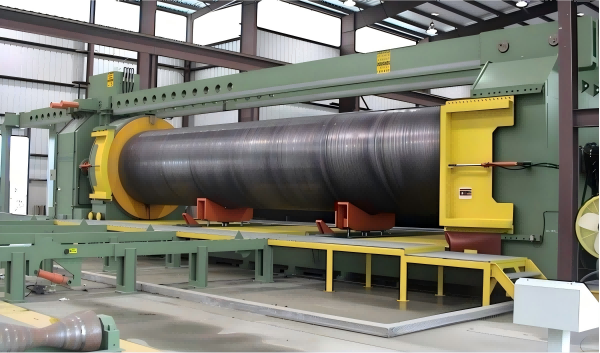
Next up is unmatched efficiency and faster lead times. Let’s do a quick comparison: a skilled worker using a manual cutter can produce maybe 10 to 12 steel pipes in an 8-hour shift, depending on size. A single automated production line can produce 50 to 60 pipes in the same timeframe, and that’s for pipes of varying diameters and wall thicknesses—no extra time needed for setup, because the line’s software can be reprogrammed in minutes. I had another client who was supplying pipes for a major highway expansion project a couple of years back. The project required 10,000 linear feet of 12-inch steel pipe to be delivered in 30 days. Their old manual setup would have taken 45 days to fulfill that order, risking penalties for missing the project’s timeline. After installing our line, they delivered the full order in 22 days. How? The line handles multiple steps in one continuous process: raw steel coils are loaded in at one end, cut to length, formed into pipe, welded, tested, and stacked at the other end—no stopping to move materials between workers or waiting for inspection. That integration cuts down on downtime that plagues manual shops, where workers have to wait for a coworker to finish their task before moving to the next. With a production line, that workflow is seamless, so you can take on more orders, meet tighter deadlines, and keep your clients happy. For many of my clients, faster lead times haven’t just increased their revenue from new projects—they’ve also built long-term loyalty, because clients know they can count on them to deliver when others can’t.
Cost savings, of course, is a big one, but it’s not just about the upfront price tag—though I’ll be honest, the long-term savings far outweigh the initial investment. Let’s talk about labor first. A full production line requires far fewer workers than a manual shop. Where you might need 6 to 8 workers to operate each manual station (cutting, welding, quality control, stacking), our line runs with 2 to 3 skilled operators who monitor the machinery and handle rare adjustments. That’s a 60% reduction in labor costs, right off the bat. Then there’s material waste. Manual cutting often results in scrap—pieces of steel that are cut incorrectly or wasted because of imprecise measurements. Our production line’s CNC system optimizes the cutting pattern to use every inch of the raw steel coil, cutting waste by up to 40%. I’ve seen clients go from throwing away 15% of their raw steel to less than 5%, which adds up over thousands of pounds of material. There’s also energy efficiency to consider. Modern production lines are designed with energy-saving features—variable speed motors, heat recovery systems for welding, and LED lighting—that use less power than a room full of manual tools and welders running all day. One of my clients calculated that their monthly electricity bill dropped by 35% after installing our line, which is another recurring cost saved. Now, I know what some skeptics say: “But I have to spend money on maintenance for the line.” That’s true, but routine maintenance on a quality line is predictable and far less expensive than the hidden costs of manual production—rework, rejected materials, overtime pay for workers rushing to meet deadlines, and lost clients due to late deliveries. Over 3 to 5 years, most clients recoup the cost of the line and start seeing consistent profit growth.
Another advantage that I don’t think gets talked about enough is the ability to adapt and grow with your business. The steel pipe industry isn’t static. Clients today might need 6-inch pipes for plumbing, next year they might need 24-inch pipes for industrial projects, and the year after that, they might need specialized pipes for solar farms or offshore wind projects. A manual shop is limited by the size of tools and the skill of its workers—you can only go so big, or so specialized, without buying new, individual tools for each job. A steel pipe production line, though, is built with modular components. You can adjust the forming rolls to make different pipe diameters, change the welding settings for different wall thicknesses, and even add on modules for coating or testing if you start taking on more high-spec orders. I had a client who started out making basic 8-inch pipes for local construction. Within two years, they were bidding on contracts for oil and gas pipes, which required higher grade steel and extra corrosion-resistant coating. They added a coating module to their existing production line, instead of buying a whole new line, and were able to start fulfilling those contracts without waiting months for new equipment. That adaptability means you don’t have to hit a ceiling when your business grows. You can start with a line that fits your current needs, and upgrade it as your client base expands. Plus, as regulations get stricter for steel pipe quality—whether it’s for environmental protection or industry safety standards—a modern production line is programmed to meet those new codes, so you don’t have to completely rework your process to stay compliant.
Quality control is another area where production lines shine, way beyond what most manual shops can offer. When you’re making pipes that will carry water, oil, or gas—materials that are used by thousands of people—quality isn’t just about customer satisfaction; it’s about safety. I’ve seen a client have to pull 2,000 pipes off a construction site because a manual weld failed a pressure test, leading to costly repairs and a hit to their reputation. With a production line, we build in in-line testing systems that check every pipe as it’s made: ultrasonic testers check for hidden flaws in the weld, pressure testers ensure the pipe can hold the required load, and dimension sensors confirm the size is correct. That means you catch defects before the pipe leaves the facility, not after it’s been installed. It’s not just about avoiding disasters, though. It’s also about building a reputation as a reliable supplier. When clients know that every pipe from your shop has passed rigorous, automated testing, they’ll choose you over competitors who can only offer manual spot checks. That reputation is worth its weight in steel, trust me.
Now, I’m not here to say that a production line is the right choice for every small shop. If you’re only making a dozen pipes a month for local residential projects, a manual setup might still work. But if you want to scale, take on larger projects, and build a business that can last 20 or 30 years, a steel pipe production line is an investment that pays off in every way.
For anyone who’s curious about how a production line could work for your specific needs—whether you’re making small-diameter plumbing pipes or large, heavy-wall pipes for industrial use—feel free to reach out. I’ve worked with operations of all sizes, and I can help you figure out the right line for your workflow, budget, and future goals. Whether you have questions about setup, maintenance, or how the line will integrate with your current processes, I’m here to help.
Pipe-making Machinery Spare Parts References
- American Petroleum Institute. (2021). Specification for Line Pipe (API 5L). American Petroleum Institute.
- Steel Market Development Institute. (2022). “Automation in Steel Pipe Production: Efficiency and Quality Impacts.” SMDI Technical Report.
- World Steel Association. (2023). “Energy Efficiency in Steel Manufacturing: Best Practices for Production Lines.” World Steel Association Publication.
- Construction Industry Institute. (2020). “Benefits of Automated Fabrication for Pipe Delivery and Project Timelines.” CII Research Report.
Tianjin Binhai Yashanway Import and Export Co., Ltd.
Tianjin Binhai Yashanway Import and Export Co., Ltd. is one of the most reliable steel pipe production line manufacturers and suppliers in China, also supports customized service with low price. Welcome to wholesale bulk steel pipe production line made in China here from our factory. Contact us for quotation.
Address: B-508, Xiangnian Plaza, Dongjiang Road, Hexi District, Tianjin, China
E-mail: crystal@yashanway.com
WebSite: https://www.yashanway.com/
